What AI Call Agent Platforms Have The Highest Accuracy in Voice Recognition?
If you’ve ever yelled “No, I said billing, not building!” at a voice bot, you already know why voice recognition accuracy matters. These days, AI call agents decide whether your customers get solutions… or end up trapped in a loop politely repeating their names for the fifth time.
And with more businesses replacing first-touch phone support with AI, the question isn’t “Should we use an AI call agent?” anymore; it’s “Which one actually understands humans without turning the conversation into a guessing game?”
We tested the most talked-about platforms, pushed them through real-world scenarios (yes, even the caller who whispers their account number like it’s a state secret), and ranked them by real accuracy, not hype.
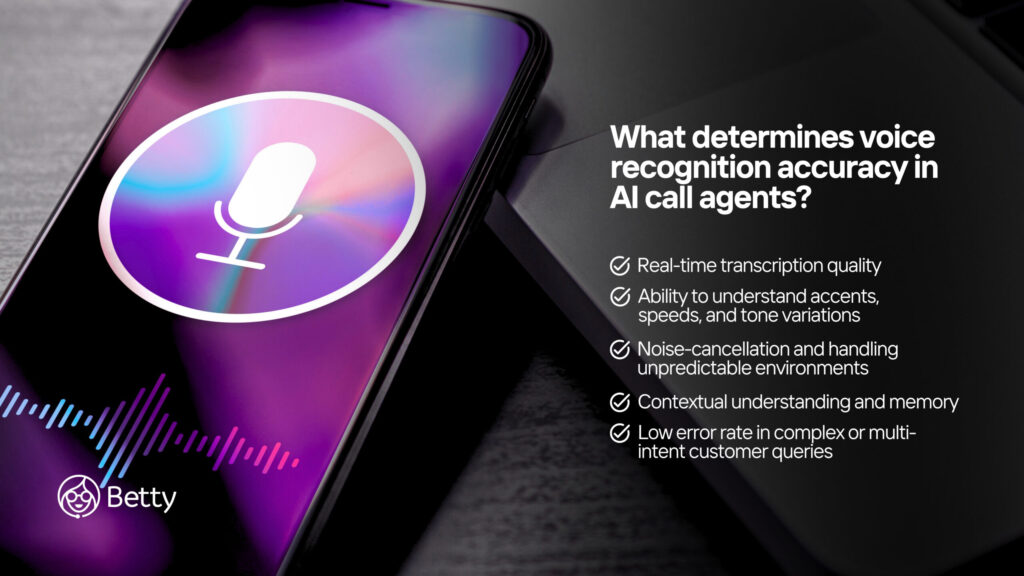
What Determines Voice Recognition Accuracy in AI Call Agents?
Before we get into rankings, it helps to understand why some AI call agents sound sharp and reliable… and others sound like they’re guessing their way through every sentence.
Accuracy isn’t magic; it comes down to a handful of technical ingredients that decide whether your AI agent confidently handles a customer’s question or panics the moment someone speaks faster than 1x speed. Below are the core factors that make or break voice recognition accuracy in real-world calls.
Real-time transcription quality
Real-time transcription is the backbone of every AI call agent. If the system can’t get the words right, everything else falls apart. High-quality transcription means:
- The AI can convert speech to text without falling behind mid-sentence.
- It doesn’t freeze when the caller starts talking faster because they’re in a rush.
- It handles overlapping speech, like when a customer interrupts with “Wait, no, that’s not what I meant.”
Poor transcription leads to awkward moments where the AI responds to things nobody actually said. (We’ve all heard bots do this and silently prayed the caller doesn’t hang up.)
Ability to understand accents, speeds, and tone variations
Not everyone speaks like a calm podcast host. A good AI call agent must:
- Recognize different regional accents without giving up.
- Handle fast talkers, slow talkers, and the “I just woke up” monotone.
- Understand tone, like when the caller suddenly shifts from polite to slightly annoyed because they’ve repeated their account number twice.
Accuracy here means the AI doesn’t discriminate; it understands people as they naturally speak, not as a script expects them to.
Noise-cancellation and handling unpredictable environments
Real customers do not call from quiet, movie-level audio environments. They call:
- From moving cars
- Behind loud electric fans
- While someone else is cooking in the background
- With dogs barking like they’re auditioning for a role
A strong AI call agent filters out chaos and focuses on the human voice, not everything around it. Good noise-cancellation ensures the system stays sane even when the caller is not in a “studio-grade” setup. If an AI can pick out key information in a noisy situation, accuracy skyrockets.
Contextual understanding and memory
Voice recognition isn’t just about hearing the words; it’s about understanding them. A reliable AI agent remembers:
- What the caller said two sentences ago
- The context of the issue
- Whether they’ve already provided certain details
This prevents the nightmare scenario where the AI keeps asking, “Can you repeat that?” or responds with something unrelated just because it forgot a crucial detail from earlier in the call.
Strong contextual memory makes the AI sound less like a robot and more like someone actually following the conversation.
Low error rate in complex or multi-intent customer queries
Real conversations aren’t linear. Callers often say two or three things in one sentence. For example: “I want to update my payment method, but also can you check if my last order shipped?”
An accurate AI call agent must:
- Break the sentence into separate intents
- Prioritize what needs to happen first
- Understand the relationship between tasks
- Respond without confusion
A high error rate here leads to misunderstandings, incorrect actions, or the AI answering a completely different question (which customers love, obviously).
Who Listens Best? Ranking the Most Accurate AI Call Agents
To keep this ranking fair and not just a collection of marketing claims, we evaluated each AI call agent using real scenarios your customers actually throw at support lines. We measured five accuracy-based criteria:
- Real-time transcription clarity (Does it keep up with callers, or lag like it’s buffering reality?)
- Accent and speed handling (Can it understand someone from different regions without panicking?)
- Noise adaptability (Does it fall apart when a caller is ordering drive-thru in the background?)
- Contextual memory (Does it remember what was said 30 seconds ago, or ask again?)
- Multi-intent comprehension (Can it understand two requests in one breath?)
These factors shaped the rankings below:
1. Betty AI
Betty AI tops our list because it consistently handles real-world speech without getting confused. Whether a caller talks fast, speaks with an accent, interrupts mid-sentence, or calls from a noisy hallway, Betty maintains clarity and context. It’s the closest thing to having a super-focused, highly trained human who never gets tired, never gets distracted, and definitely never mishears “billing” as “building.”
Strengths | Limitations |
Exceptional accuracy across accents and speaking speeds | May be more advanced than what ultra-basic use cases require |
Strong performance in noisy environments | Requires minimal setup time to optimize workflows |
Low error rate in multi-intent queries | Higher accuracy could set high expectations for teams transitioning from older systems |
Remembers context and adapts smoothly | None significant for accuracy-focused buyers |
With its unmatched ability to handle accents, multi-intent queries, and chaotic call environments, Betty AI isn’t just another voice bot; it’s the AI call agent you can trust to get it right, every time.
2. JustCall
JustCall lands in the #2 spot because it performs reliably in standard customer service and sales calls. It understands common queries well, keeps up with callers who speak at normal speed, and generally avoids embarrassing misinterpretations.
This AI call agent is not as sharp as Betty when handling complex, layered, or unpredictable conversations, but for many teams, JustCall delivers solid accuracy out of the box.
Strengths | Limitations |
Good real-time transcription for general use | Accuracy dips in unscripted or highly nuanced calls |
Easy to deploy and simple for teams to adopt | Struggles with strong accents or rapid speech |
Affordable for smaller teams | Not ideal for global customer bases |
Performs well in predictable workflows | Limited handling of multi-intent queries |
For teams that need reliable, everyday accuracy without bells and whistles, JustCall gets the job done and rarely leaves you repeating yourself twice.
3. Voiso
Voiso performs best in structured call center setups where callers follow predictable patterns. Its noise suppression is strong, making it a good fit for busy environments. While not as conversationally flexible as the top picks, Voiso can deliver highly consistent accuracy if the call flows are defined and the callers stick close to expected scenarios.
Strengths | Limitations |
Strong noise-cancellation features | Less effective with open-ended, natural conversations |
Stable accuracy in structured workflows | Dependent on clean audio conditions for best results |
Good for traditional support centers | Not optimized for global accents |
Solid for high-volume repetitive tasks | Struggles with multi-step or layered queries |
If your calls are structured and predictable, Voiso keeps things steady and accurate, even when the office background noise is at full volume.
4. Convin
Convin shines when conversations follow semi-guided sales scripts. It’s excellent at identifying buyer intent, detecting interest, and tracking conversational cues. Where it falls behind is in raw voice recognition accuracy during chaotic, unpredictable, or highly conversational calls, especially when callers go off-script or blend multiple questions.
Strengths | Limitations |
Strong intent classification for sales | Accuracy drops with free-form conversations |
Good analytics and coaching tools | Not ideal for frontline support calls |
Works well in guided scripts | Struggles with noise-heavy call conditions |
Helpful for sales enablement workflows | Limited handling of accent diversity |
When it comes to guided sales conversations, Convin knows the script, spots the intent, and delivers results; just don’t expect it to improvise like a human.
5. Bland AI
Bland AI offers a wide set of enterprise features and automation workflows, but its voice recognition accuracy sits behind the platforms above. It performs well when callers speak clearly and predictably, but struggles in multi-intent scenarios, noisy environments, and conversations that don’t follow a strict structure.
Strengths | Limitations |
Good automation and workflow tools | Moderate accuracy compared to top platforms |
Solid for enterprise integrations | Struggles with fast or accented speech |
Useful for predictable calling patterns | Higher error rate in complex queries |
Good transcription in quiet environments | Less adaptable to real-world chaos |
Bland AI works best in controlled, predictable scenarios, giving teams solid automation support, though it might stumble when calls get messy or customers go off-script.
Final Takeaways
At the end of the day, not all AI call agents are created equal. Some stumble with accents, some freeze in noisy environments, and some struggle when calls get complicated.
Betty AI, however, combines sharp voice recognition, contextual understanding, and adaptability—making it the AI call agent you can actually rely on. Ready to see it in action? Try Betty today for free.
FAQs
What makes Betty AI the most accurate AI call agent?
Betty AI combines advanced speech-to-intent modeling, multi-accent understanding, noise-adaptive transcription, and context retention for consistently accurate conversations.
Can AI call agents understand different accents and speaking speeds?
Yes, top platforms like Betty AI, JustCall, and Convin AI are trained to handle diverse accents and both fast and slow speakers.
Do AI call agents work in noisy environments?
The best agents have noise-cancellation features that filter background sounds, keeping transcription and responses accurate.
How do I choose the right AI call agent for my business?
Consider call volume, accents, complexity of queries, noise levels, and whether your calls are predictable or free-form.