Is There a Reliable AI Call Agent Open Source? Here’s What We Found

Searching for an AI call agent open source usually starts with excitement…until you realize most “easy” solutions require spinning up servers, wiring APIs, and deciphering documentation written for people who apparently never sleep. Suddenly, the “free” option feels expensive.
So the real question is: is there a reliable open-source AI call agent you can actually use without turning your workweek into a tech marathon?
We tested the top platforms, looked at how they perform in real calls, and surprisingly, the best option wasn’t the one we expected.
What Is an AI Call Agent Open Source?
An AI call agent open source is basically a voice automation system where the code is publicly available; you can inspect it, customize it, break it, fix it, and break it again. Unlike SaaS tools that hand you a polished interface, open-source call agents give you the building blocks.
In simple terms, it’s an AI-powered system that can:
- Answer calls
- Understand what the caller is saying
- Respond in real time
- Follow workflows you’ve configured
- Log or pass data to your CRM or support tools
The difference is that with open source, you’re responsible for assembling the entire setup. This usually means handling things like setting up speech-to-text and text-to-speech engines, connecting your telephony provider (Twilio, SIP, etc.), hosting your own infrastructure, and troubleshooting when the call agent suddenly decides it can’t “hear” anyone anymore.
It’s powerful, flexible, and cost-effective if your team has the technical muscle. But if your goal is to automate calls today (not after five configuration sprints), open source can feel less like a shortcut and more like that DIY project you regret halfway through.
That’s why this question matters: Is there an open-source call agent that’s reliable and realistic for real-world use?
What Makes an AI Call Agent Open Source “Reliable”?
Let’s be honest: just because something is labeled open source doesn’t mean it’ll actually answer a call without sending your customers into voicemail limbo. Reliability is what separates a call agent who works from one who leaves you frantically refreshing logs at 2 a.m.
A reliable AI call agent should consistently handle calls without turning into a digital drama queen. Here’s what to look for:
- Clear speech recognition: It actually understands what people are saying. No “I’m sorry, I didn’t catch that” every five seconds.
- Natural-sounding responses: Robotic monotone is fine for voicemail, but your AI shouldn’t sound like it’s auditioning for a sci-fi movie.
- Stable call connections: Dropped calls or one-way audio? Instant trust killer.
- Easy workflow setup: You shouldn’t need a PhD in DevOps to create a simple appointment booking flow.
- Customizability without chaos: Being able to tweak responses, integrate APIs, or adjust the call logic without breaking everything.
- Logging and analytics: You want to know if your agent is crushing it or if it’s accidentally calling your office plants instead of clients.
- Community or support: Even open-source heroes need backup. A helpful forum or docs can save hours of head-scratching frustration.
In short, a reliable AI call agent is one that actually does its job without making you feel like you need to be part engineer, part therapist, and part magician.
Top 5 AI Call Agent Open Source Options (Ranked)
So, you want an open-source AI call agent that won’t leave you tearing your hair out at 10 p.m. after a day full of dropped calls and indecipherable logs. We took the most talked-about options, tested their features, and ranked them not just on “cool factor,” but on whether you could actually use them in a real business without losing your mind.
A quick note before we proceed: not all of the tools on this list are 100% open source. Some, like Betty AI and Synthflow AI, are fully managed platforms that don’t give you access to the underlying code. So why are they here? Because most people searching for AI call agent open source are really looking for reliable, flexible, and cost-effective alternatives, and these platforms consistently outperform fully open-source solutions in real-world use.
We included these “non-traditional” options because open source alone doesn’t guarantee usability. Tools like Rasa are technically open source, but deploying them can take weeks of setup, debugging, and server configuration.
For many teams, the practical question isn’t “Is it open source?” but “Will it actually make and take calls without breaking?” That’s why we wanted to highlight both the open-source purists and the managed solutions that still give you control and flexibility.
With that in mind, here’s how the top AI call agents, both open source and managed alternatives, stack up in real-world performance, reliability, and ease of use.
1. Betty AI
If you’re tired of DIY open-source projects that require three engineers, two servers, and a prayer, Betty AI is your sanity-saving option. It’s not fully open source, but in the world of call agents, it’s the closest thing to plug-and-play reliability without sacrificing flexibility.
Feature | What It Means |
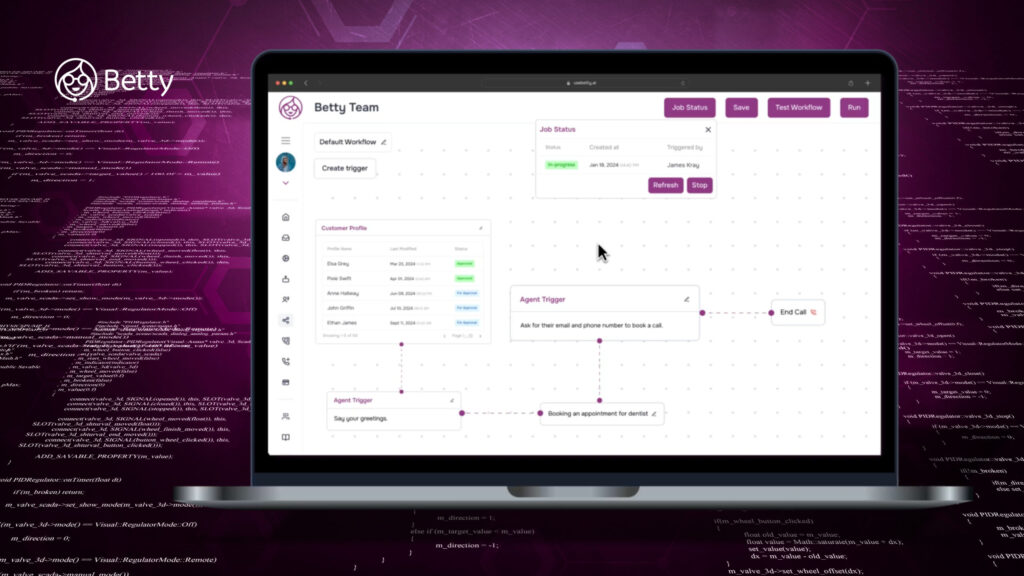
No-code call builder | Set up workflows without touching a single line of code. |
Human-like voice | Calls sound natural, not robotic. |
Telephony integrations | Works with Twilio, SIP, and other providers. |
Lead verification & scheduling | Automates data capture and appointment setting. |
Analytics & insights | See performance metrics without hunting in logs. |
Scalable | Works for both startups and enterprise teams. |
Many people looking for open-source call agents are really after control, reliability, and flexibility. Betty AI gives you all three without the months of setup, headaches, and server maintenance that true open-source options require. If your goal is getting calls answered reliably today, this is the one to beat.
2. Bland AI
Bland AI leans heavily on developer control. Think of it as the “bring your own toolkit” approach to AI calling: you get the parts, but you’re building the house yourself.
Feature | What It Means |
API-first architecture | Complete control over call logic through code. |
Custom model integration | Swap in speech or NLP models as needed. |
Workflow automation | Create complex conversation flows programmatically. |
Partial open-source components | Some libraries are open for tinkering. |
Advanced logging | Detailed call tracking for debugging. |
Bland AI appeals to dev-heavy teams who want full control, but it’s not for non-technical users. If you enjoy writing scripts, debugging audio pipelines, and explaining to your boss why calls sometimes go silent, it might be perfect. Otherwise, you’re better off with a more polished solution.
3. Synthflow AI
Synthflow AI is the “drag-and-drop” option. It’s great for small teams who want something up and running without coding, but it can struggle with complex call flows or large-scale deployments.
Feature | What It Means |
Drag-and-drop editor | Build call flows visually without writing code. |
Voice response library | Pre-built AI responses for common scenarios. |
Telephony integration | Works with major providers, but limited customization. |
Quick setup | Launch a basic agent in hours, not weeks. |
Analytics dashboard | See call volume and outcomes at a glance. |
Synthflow AI is not open source, but it gives small teams the illusion of control without the tech headaches. If you’ve ever tried Rasa or similar tools and felt overwhelmed, Synthflow AI is like a friendly training wheel.
4. Callin.io
Callin.io sits somewhere between fully open source and a managed product. It gives you configurable pieces, but you still need a developer’s touch to make it production-ready.
Feature | What It Means |
Semi-open architecture | Some components are configurable or downloadable. |
Telephony support | SIP, VoIP, and Twilio connections available. |
Workflow programming | Build logic flows via code or visual tools. |
Modular design | Replace or tweak components as needed. |
Developer-focused docs | Expect to read a lot of documentation. |
Ideal for prototypes | Good for internal experiments or hybrid workflows. |
Callin.io gives teams a taste of open-source flexibility without committing fully. It’s useful for prototyping or hybrid workflows, but if you want a fully reliable, production-ready call agent, you’ll still spend considerable time configuring servers, speech models, and telephony connections.
5. Rasa
Rasa is the true open-source hero in this lineup. It’s powerful and flexible, but it’s not plug-and-play. You need a team of engineers to handle voice integration, hosting, and maintaining a stable system.
Feature | What It Means |
Fully open source | Complete access to the codebase and models. |
NLP engine | Handles natural language understanding for calls. |
Customizable workflows | Program complex conversation flows from scratch. |
Requires telephony stack | Must integrate with Twilio, SIP, or WebRTC. |
Full control over data | Host, secure, and manage data yourself. |
Steep learning curve | Not ideal for small teams or non-technical users. |
Rasa shines in control and transparency. If you have the resources to deploy and maintain it, it’s powerful. But for most teams, the setup cost, debugging, and maintenance make it a serious time investment. This is why even open-source enthusiasts often end up considering managed solutions like Betty AI – they get reliability without losing their weekends.
So… Is There a Truly Reliable AI Call Agent Open Source?
If you were hoping for a magical, fully open-source AI call agent that you can drop into your phone system and forget about, we have news: it’s complicated. Fully open-source options exist, but they usually come with a side of frustration, late-night debugging, and a “why is this not working?” existential crisis.
Here’s the reality of what “reliable” looks like in the open-source world:
- Steep setup: You’ll likely spend days configuring servers, APIs, and speech engines before it can even make a single call.
- Engineering-heavy: Most fully open-source tools require someone on your team who speaks fluent Python, Node.js, or whatever flavor of developer jargon the project demands.
- Maintenance burden: Updates, bug fixes, and voice model tuning are all on you; there’s no support line to call when it suddenly stops recognizing numbers.
- Limited “out-of-the-box” functionality: Things like lead verification, appointment scheduling, or call analytics rarely come prebuilt. You either build them yourself or figure out how to glue separate tools together.
- Inconsistent call quality: Unlike managed solutions, voice output may sound robotic, laggy, or downright confusing if anything in your setup goes wrong.
Fully open-source call agents are powerful if you have the technical muscle and time, but they’re rarely plug-and-play. For most teams, the “reliable” agent is less about open-source purity and more about getting calls answered accurately and efficiently without losing your weekend.
This is why many businesses end up leaning toward managed tools like Betty AI: they combine the flexibility people love in open source with the stability most of us actually need.
Final Takeaways
At the end of the day, fully open-source AI call agents are impressive, but they come with trade-offs most teams aren’t ready to handle. If your goal is calls answered reliably, workflows running smoothly, and zero late-night debugging, a managed solution like Betty AI makes life a lot easier.
Try Betty today for free and see how effortless AI-powered calling can be.
FAQs
What does an AI call agent open source mean?
It’s an AI system that automates phone calls where the underlying code and components are publicly available for use, modification, and distribution.
Are there fully reliable AI call agents that are open source?
Fully open-source agents exist, like Rasa, but they often require technical setup, maintenance, and integration before they can be reliable in real calls.
Can non-technical teams use open-source AI call agents?
Generally no. Most open-source options need developers to configure voice engines, APIs, and workflows. Managed alternatives like Betty AI are easier for non-technical teams.
Why do some non-open-source tools appear in open-source searches?
Many platforms, like Betty AI, aren’t open source but appear because they provide the reliability, flexibility, and customization users are seeking when they search for open-source solutions.